Commercial Snow Removal Contracts in NJ: How to Choose Before the First Storm
The short answer: lock in a commercial snow removal contract in October, before routes fill — waiting until a storm is in the forecast means picking from whatever capacity is left, at whatever price is left. Seasonal flat-rate contracts and per-push billing solve different problems, and the wrong choice for your property can cost more in liability than it ever saves in fees.
When should a commercial property sign a snow removal contract in NJ?
As early in the fall as you can, and October is the practical deadline. Snow contractors build their routes before the season starts, and accounts that are locked in ahead of time get priority placement on that route. A property manager who waits until a storm is in the forecast is choosing from whatever capacity a crew has left over — which, by late November, may mean per-push only, a longer response window, or no opening at all with a contractor you'd otherwise prefer.
Crews here run on-call from November through March, monitoring National Weather Service alerts and mobilizing before accumulation starts. That proactive model only works for properties already on the route. Sign in October, and your lot is one of the ones the crew is already planning around before the first flake falls.
Seasonal contract or per-push pricing — which fits my property?
A seasonal contract is a flat fee covering unlimited plowing pushes from November through March. It typically bundles pre-salting ahead of every forecasted storm, priority dispatch, and a post-storm follow-up push to clear stacked snow from walkways and entrances — all for one predictable number, regardless of how heavy the winter turns out to be. That predictability is the point: a board or facilities budget doesn't get blindsided by a run of back-to-back storms.
Per-push pricing is invoiced per storm event, based on accumulation depth and lot size, with no minimum commitment — you only pay for services actually rendered. It's a reasonable fit for a property with a tight budget or a genuinely light-snow-year bet. The trade-off is dispatch priority: per-push clients are served after seasonal contract clients during a peak storm, which matters most for properties that can't afford to open late — a retail plaza on a Saturday morning, a gym before the 5 AM rush.
What should I ask a snow removal contractor before signing?
- What accumulation depth triggers dispatch? A vague "when it snows" isn't a service standard — ask for the trigger depth in writing.
- Is pre-treatment included, and what kind? Liquid brine and granular rock salt aren't interchangeable — see below.
- Does the push cover walkways, entrances, and loading docks, or only the main lot? Slip-and-fall risk concentrates at entrances, not the middle of a parking field.
- What happens during back-to-back storms? Ask how stacked snow at curb lines and islands gets handled after several storms in a row.
- What equipment is actually deployed to your property? Not every contractor runs the same gear — see the next question.
- Are they licensed and insured for commercial work? A slip-and-fall claim on an uncleared lot lands on whoever's contract governs that property.
Why does the equipment a contractor runs matter?
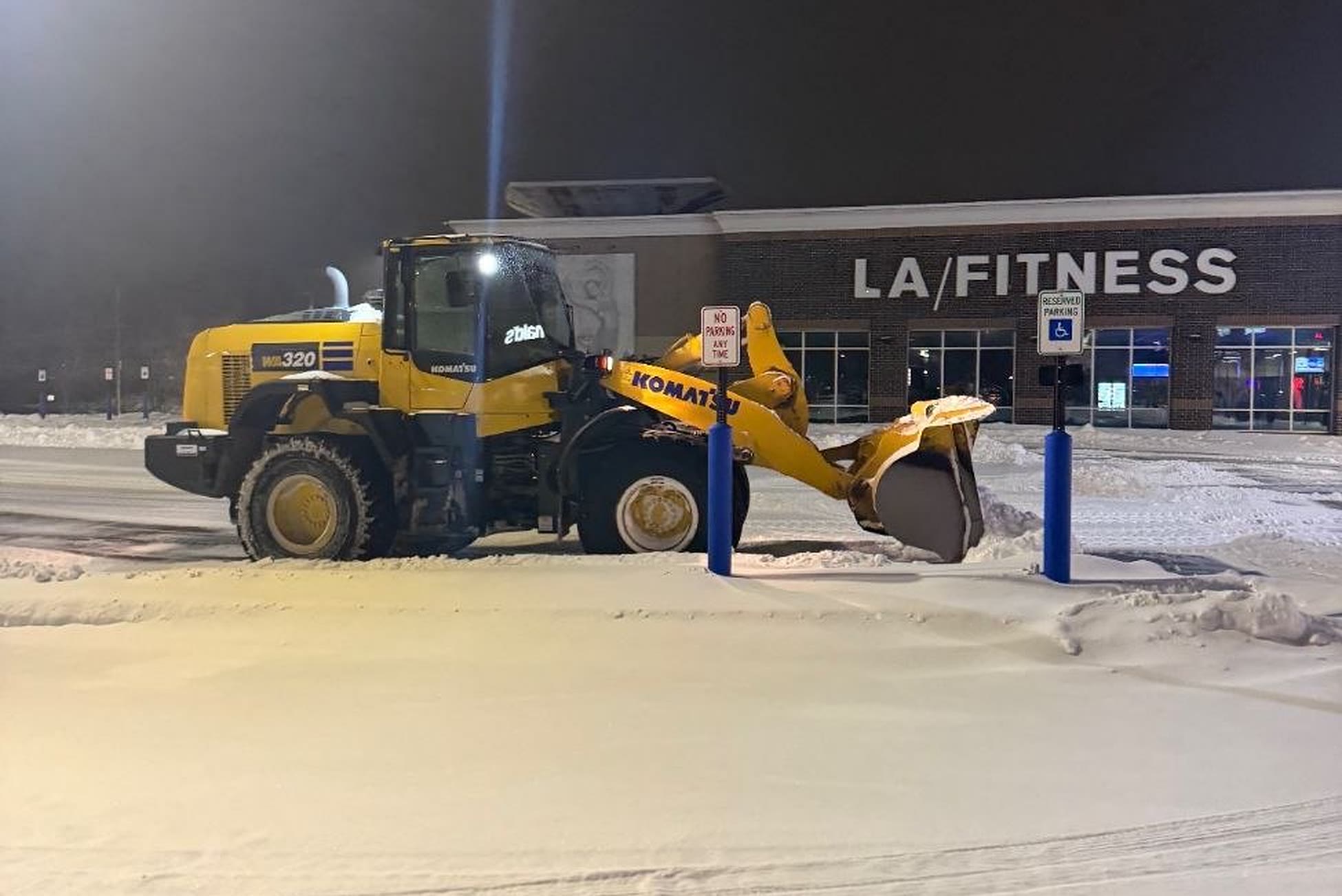
Commercial-grade equipment clears large lots differently than a residential plow truck bogs through them. Wheel loaders fitted with Arctic Sectional Sno-Pushers push much larger volumes of snow in a single pass than a standard straight blade, and because sectional pushers contain the load instead of spilling snow off the sides, a lot gets clean in fewer passes. Sectional pushers also flex over uneven pavement, which spares curbs and speed bumps the cracking that rigid blades routinely cause.
Skid steers handle what wheel loaders can't reach — tight spaces, loading docks, and areas around parked cars — and a contractor running multiple skid steers on a large property can clear different zones simultaneously instead of working the whole lot in sequence. If a contractor can't describe what equipment shows up at your address, that's worth a second question before you sign.
Is pre-treatment actually worth paying for?
Yes, and the mechanism is straightforward: liquid brine or granular salt applied up to 24 hours before a forecasted storm prevents ice from bonding to the pavement in the first place, which dramatically cuts cleanup time once the storm passes. Liquid brine applied ahead of a storm is roughly 30–40% more effective than dry salt applied after snowfall has already started, and it uses less material to do it — which is why seasonal contracts that bundle pre-salting tend to produce cleaner lots for less total product than a per-push job that only reacts once snow is already down.
Which properties need a locked contract the most?
Some property types carry more downside from a gap in coverage than others:
- Commercial parking lots — slip-and-fall liability starts the moment customers or employees step out of their cars.
- Retail plazas and strip malls — foot traffic and storefront access are the business; a late plow is a lost sales day.
- HOAs and condominiums — boards are on the hook for common driveways and walkways, whether or not a contract is in place.
- Fitness centers and gyms — early-morning and late-night hours mean lots need to be clear well outside a typical 9-to-5 plow window.
We run commercial snow operations across Middlesex, Monmouth, Ocean, Essex, Union, and Bergen counties in New Jersey, plus Brooklyn, Staten Island, and Queens — two markets most plowing companies pick one or the other of. If you manage a property in any of those areas, our seasonal and per-push commercial snow removal contracts are worth comparing against whatever you signed last year, especially if last winter's response times left something to be desired.
Get your lot on the route before the first storm
Seasonal and per-push commercial snow removal across Middlesex, Monmouth, Ocean, Essex, Union, and Bergen counties — plus Brooklyn, Staten Island, and Queens.
More from Turf Boss: our full project portfolio · commercial snow removal · custom putting greens