Yard Drainage Problems in New Jersey: Causes, Fixes & When to Call a Pro
Standing water in a NJ yard almost always traces back to one of three things: poor grading, a base that doesn't drain, or nowhere for the water to go once it reaches the low point. The right fix depends on which one you're dealing with — regrading, a French drain, a dry well, or rebuilding the base under a hardscape — and getting it sorted before the ground freezes saves a far more expensive repair after a winter of freeze-thaw cycles.
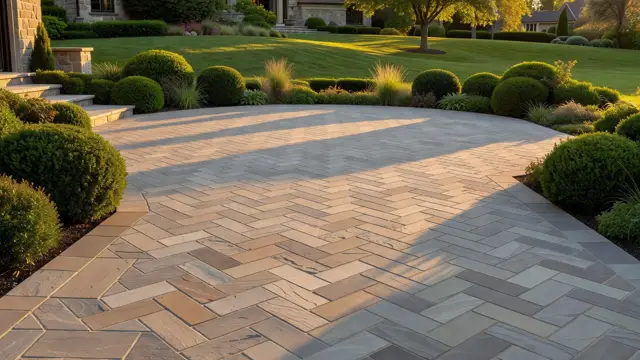
What causes standing water or drainage problems in a NJ yard?
Most New Jersey properties have heavy clay-loam soil that drains slowly to begin with, so the yard doesn't have much margin for error. Add a flat or negatively-graded lawn — one that slopes toward the house instead of away from it — and water that should run off instead collects against the foundation, under a patio, or in a low spot in the lawn.
The other common cause is underneath a hardscape rather than on top of it. A patio, walkway, or driveway built on a shallow or poorly compacted base traps water in the sub-base instead of letting it pass through, which is also what leads to frost heave once that trapped water freezes in January.
How do I know if it's a grading problem or a base problem?
Watch where the water sits. If it pools across open lawn, near the foundation, or at a low spot that was always "the wet corner," that's a grading issue — the ground's slope, not any hardscape, is sending water to the wrong place. The fix is usually re-contouring the soil so it falls away from the house at a consistent slope, roughly 2% (a 1/4-inch drop per foot), out to a spot where it can disperse or be collected.
If the water shows up specifically along the edge of a paver patio, in the joints, or as a soft, squishy base when you walk on it, that points to the sub-base underneath. Pavers that are already rocking, settling unevenly, or holding water in the joints after rain usually need the base rebuilt, not just resealed or re-sanded on top.
What's the difference between a French drain, a dry well, and a catch basin?
These solve the same problem — getting water somewhere it won't cause damage — in different ways. A French drain is a gravel-filled trench around a perforated pipe that intercepts water moving through the soil and carries it, by gravity, to a lower discharge point; it's the right tool for water that's moving laterally underground toward a foundation or low area.
A dry well is a buried gravel- or chamber-filled pit that collects water (often from a downspout or a French drain's outlet) and lets it slowly percolate into the surrounding soil, which is useful on a property with no good spot to discharge water above ground.
A catch basin is a grated inlet set at a low point — the bottom of a driveway, a patio corner — that collects surface water pooling right there and pipes it away, rather than relying on it to flow to a trench. Many drainage plans combine two of these: a catch basin at the low point feeding a pipe to a dry well, for example.
Can permeable pavers or synthetic turf help with drainage?
Both can, but neither replaces proper grading if the underlying slope is wrong. Permeable paver systems use a deeper, open-graded stone base and wider joints so rainwater passes straight through the surface into the base and the soil below, instead of running off to the lowest point in the yard — useful on a patio or driveway where surface runoff is part of the problem.
Quality synthetic turf is built with a perforated drainage backing that passes water through at a high rate, so a properly installed turf lawn won't hold puddles the way bare or thin natural grass can. See our synthetic turf products for the drainage specs on each one. Either option still needs a base that's graded and compacted correctly — it's a piece of the system, not a substitute for it.
Do gutters and downspouts affect yard drainage?
Often more than people expect. A roof sheds a large volume of water, and if downspouts dump it a foot from the foundation, that water has nowhere to go but sideways — straight toward the house or a nearby patio base. Extending downspouts several feet away from the foundation, or tying them into a buried pipe that runs to a dry well or a daylight outlet, removes one of the biggest single contributors to a wet yard before any other fix is needed.
This is also worth checking before winter: a downspout extension that's cracked, disconnected, or clogged with leaves will send roof runoff exactly where you don't want it during a thaw.
When should I call a professional instead of DIY-ing it?
A downspout extension or clearing a clogged drainage channel is reasonable to handle yourself. Regrading near a foundation, installing a French drain that needs to tie into an existing storm drain or daylight correctly, or rebuilding the base under a sunken or heaving patio are jobs where getting the slope or the pipe sizing wrong just moves the water problem somewhere else — often onto a neighbor's property, which can create its own issues. If you're seeing recurring standing water, a patio that's visibly settled, or water intrusion near the foundation, that's the point to get a professional grading and drainage assessment rather than trying another round of topsoil and grass seed. Request a free estimate and we'll walk the property with you.
Get Your Drainage Fixed Before Winter
We handle grading, French drains, paver base rebuilds, and drainage-backed synthetic turf across Middlesex, Monmouth, Ocean, Essex, Union, and Bergen counties — plus Brooklyn, Staten Island, and Queens.
More from Turf Boss: our full project portfolio · synthetic turf products · winterizing pavers & turf · choosing patio pavers · fall outdoor maintenance checklist